
Religion’s propagators – not religion per se – are to blame for vilification, discord and war among peoples


WarsCausedByReligiousDifferences-530-nocapMost of the wars on earth have been labeled “religious” or “holy” because they were caused by differences in religious doctrine – and by religious urgings. Those wars that included the Jewish conquest of the Levant, the Muslim invasions, and the Roman Catholic Crusades were engendered by the ungodly enmity between propagators of three principal religions: Judaism, Christianity, and Islam.

Armed conflicts in today’s world are the result of one or another religion’s determination to spread gospel and expand flock, or to eliminate competition. While it is true that some wars are caused by economic, cultural or political factors, it is an undeniable and inescapable fact that those wars are also inspired – to some extent – by religious goals.

Meanwhile, Hinduism, Chinese folk religion, and Buddhism – and the minor religions Taoism, Shintoism, Sikhism, Korean Shamanism, Caodaism, Bahá’í Faith, Jainism, Cheondoism, Haohaoism, and Tenriism – are pacifist and have never considered coercion as a means of propagating their beliefs.

Why then do Jews, Christians and Muslims frequently get involved in wars and become authors of death and destruction? While all three religions worship the same God, many in their leadership – those responsible for propagating the faith – make it a mission to win fealty by coercion.

The Yugoslav wars between Slovenia, Croatia, Bosnia, Kosovo, Presevo and Macedonia (component states of the once-united Yugoslavia) showcased the antagonism between Christians and Muslims – and in many cases, between Sunni and Shiite Muslims.

The civil wars in Sudan, though mostly rooted in ethnic differences, were largely fueled by intolerance between various Islamic sects.

The ongoing Israeli-Palestinian conflicts are caused by the refusal of Palestinians and the Islamic states, including Iran, to recognize Israel as a sovereign nation, while instead promising Israel’s ultimate destruction.

The Syrian civil war, although a rebellion to oust the country’s dictatorship, has become a desperate attempt by several Islamic sects to control as much territory and people as possible. ISIS (or ISIL) is an apparent fundamentalist Muslim attempt to avenge the Jewish invasion of the Levant which took place centuries ago.

Conflicts in Afghanistan and Iraq are primarily wars between the Shiite and Sunni faiths of Islam. Historically and philosophically, these two religious sects cannot, by their own avowals, coexist.

In the Philippines, a decades-long war is being waged between the primarily Catholic population and the country’s Muslim minority.

About 10 million people perished during the Thirty Years War between Protestants and Catholics; 4 million people died in the French Wars of Religion between Protestants and Catholics; 2 million people were killed during the Second Sudanese Civil War between Christians and Muslims; 3 million people were annihilated in the Crusades when Christians tried to erase Muslims from the face of the earth; and 250,000 men, women and children died during the Lebanese Civil War between Christians, Shiite Muslims and Sunni Muslims.

Because of the preaching and teachings of religion’s propagators, neighbors in local communities have become distrustful of each other. In democratic and multicultural societies, Christians have become paranoid and fearful of their Muslim neighbors and vice versa, even as they share the same social and political environment.

Christian theologians and preachers should stop professing that non-Christians are bound for hell – and Muslim imams and mullahs must cease asserting that all who do not adhere to Islam must die.

Religious leaders should consider good will and peace among people as their primary goal, which – by their own tenet – is God’s will.

Religious leaders should stop the aggressive propagation of their faith.

Posted in Uncategorized | Tagged , , , , , , , , , , , , , , , , | 1 Comment

Ahmed Mohamed and his encounter with a bigoted, socially conservative Southern culture


AhmedMohamed&IvingPolice-2Ahmed Mohamed is a bright and resourceful 14-year-old inventor who has been keeping himself busy creating various electronic devices. Recently, he built an electronic clock, from scratch. He bragged about his latest creation to one of his teachers at MacArthur High School in Irving, Texas. The teacher dutifully asked Ahmed to bring the clock in to school to show off to his schoolmates.

Ahmed brought the clock to school, and the very same teacher – not bright enough to tell the difference between a clock and a bomb – detained Ahmed and summoned the Irving, Texas police.

The Irving police were so eager to hit the news headlines and be lauded for their counter-terrorism efforts that – without first looking at the clock and determining its nature – they promptly placed Ahmed in handcuffs and under arrest.

Ahmed’s arrest on suspicion of terrorism is a result of the bigoted, socially conservative culture of most people in Southern states of the union. Middle Eastern and Muslim Americans are especially vulnerable to Southern bigotry.

The height of this conservative bigotry was further demonstrated when neither the Irving police nor the teacher who caused his arrest or the MacArthur High School administration gave or offered to give Ahmed or his family an apology. Nor did anyone of those who humiliated and vilified Ahmed so much as suggest that the incident would never happen again, because to their thinking it may and it will.

Our country’s real problem is not only the possible existence of terrorists within and without our borders. Our country’s problems include those of us who are constantly on their toes fearing and suspecting their fellow countrymen and neighbors of being terrorists. America needs to rid itself of fear-mongers and ultra-right wing radicals who engender suspicion and hatred among our people.

Our worst enemy is bigotry and a socially conservative culture.

Posted in Uncategorized | Tagged , , , , , , , , , , , , , , , , , | 1 Comment

Why Syrian and Middle Eastern refugees flee to Europe and not to their affluent Arab neighboring states


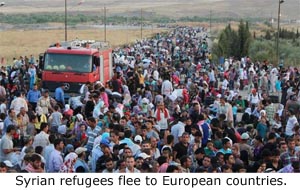
SwedenTakesInMoreMigrants-300There are ‘complaints’ that affluent Arab countries such as the Gulf States and Saudi Arabia are not contributing their share and providing asylum to Syrian and other Middle Eastern refugees. Let’s get things straight: those Syrian and other Middle Eastern refugees are fleeing to – and knocking on the doors of – European Union countries because that’s where they want to be.

Had the refugees considered their Arab and Middle Eastern neighbors as desirable destinations, they would have proceeded to those countries instead, considering that those neighboring Arab and Middle Eastern nations are a lot closer and much easier to enter.

The refugees risk their lives – together with those of their sometimes infant children – to cross mountains, seas and intervening lands just to get to their chosen place on earth.

Since the refugees do not intend to – and are not interested in – seeking asylum in their neighboring Arab countries, it would be inane for those countries to offer succor to their misplaced brethren. Any such offer of asylum by the Arab countries would simply be rejected by the refugees.

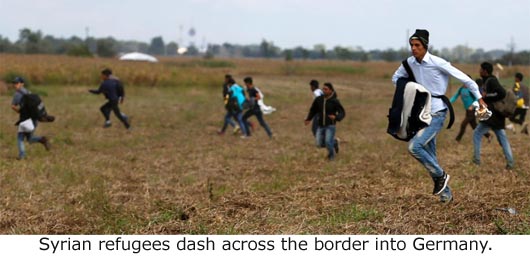
MigrantsDashAcrossBorderToGermany-530Syrian and other Middle Eastern refugees are escaping a war and persecution, and are grabbing at an opportunity to flee to a place where they can rebuild their lives – a place where they could be productively employed and, more importantly, where they could enjoy freedom from autocratic or theocratic rule.

Every person on earth wants to live in a place where they are free to exercise their basic human rights: their freedom of speech and religion, and their right to pursue happiness. When one lives in an autocratic or religious state or society, those freedoms are suppressed and even denied.

Every person on earth wants to be productively employed, to have a family, and to participate harmoniously in the social milieu. It does not matter the form of government they fall under, or the kind of society they live in, or the part of the world they end up in – as long as they are able to live freely, productively and peaceably among their fellowmen.

Unless Saudi Arabia and the rest of the Arab states provide the media and conditions for a good human life, no refugee would – in their right mind – seek or accept their hospitality.

Posted in Uncategorized | Tagged , , , , , , , , | Leave a comment

A peek into the 22nd Century: Urbanites living in environment-friendly luxury, in harmony with nature


22ndCenturyCities-WithFarms&Factories-01What would we see if we looked into the future – into the year 2101?

In the last half of the 21st Century, earth was in trouble – the environment had been mostly polluted, the ozone layer almost gone, and global warming had reduced earth’s land area by three percent. The earth’s population had hit the 15-billion mark and kept growing. Mars did not offer any hope for habitation – seven pilgrimage ships to the red planet ended in disaster – 236 humans gave their lives in the process.

Earth was the only home for the human race. In 2050, the United Nations approved a “life plan” for the mandatory use by all nations on earth: “people are to live in compact communities of high-rises surrounded by farms and factories where they would work.” All the people are to live “closely together to enjoy the same society and community” – and to conserve space and protect the environment!

And so we move to the year 2101 and take a look at our future life on earth.

22ndCenturyCities-WithFarms&Factories-02Everyone lives in a metropolis – a city made up of high-rise residential complexes immediately surrounded by farms and factories. There are no single-family home subdivisions or sprawled developments. Farms and factories are in multilevel buildings located immediately next to high-rise homes.

The high-rise complexes of homes include shops and entertainment centers. People travel (by foot or bicycle) to and from immediately surrounding farms and factories for work. People walk or cycle to shop or for entertainment within their communities. Some cities have fully automated electric subway systems that take folk from one place to any other part of the city, for free. And the subway systems connect to high-speed electric rail or airship stations for trips between cities, states or countries.

People’s homes are ultra-modern, fully automated. Dirty linen and laundry get shot through tubes into the wash room and into intelligent, self-programming washing machines. Every nook and cranny of the home is automatically non-intrusively cleaned by robots. Every room automatically air-conditioned to feel. Kitchens are fully automated: just pour all the ingredients in a pot and tell the pot what to cook (via you phone or the pot’s controls). Automatic dishwashers take in all dirty dishes and do the work. People can actually program their household robots to do certain tasks once and for all.

All homes are equipped with free wireless Internet – and thus, free TV and home movies (all paid for by advertising), free phone access to anywhere in the world (because of free Internet), and the newest yet: just one device which can be hung down a neck, tied around a waist or placed in a pocket or purse.

22ndCenturyCities-Farms&Factories-03Ninety-nine percent of the earth’s population is vegetarian. Hence there are no commercial animal or poultry farms – and fishing is a thing of the past. All farms are organic vegetable. Human beings are healthier, slimmer and taller. Hardly anyone remembers what a cigarette or tobacco is or looks like.

Doctors and hospitals are obsolete. People walk to a kiosk where they hook themselves up to medical-analyst systems and get a super diagnosis: in two minutes flat they learn what they miss in diet, exercise and mental activity and are prescribed the medication or action needed – all in one print-out. For medication, people go to a store; for surgery or other intrusive requirement, they visit a robotic clinic where they are administered, error-free, for free.

Religion is a thing of the past. People meditate and self-introspect in their privacy. No one talks about or brags of his or her inner-self practices – people simply have the habit of trying to be better members of society and live in harmony with their fellow beings, human or otherwise.

Schoolchildren engage in mental calisthenics more than physical sports but are physically engaged through group jogging. High school and college sports are limited to marathons and brisk walking competitions. Entertainment does not include professional sports – entertainment is limited to singing, dancing, the stage and cinema. Boxing is obsolete.

Electric airplanes take off and land vertically and electric trains zip by at 500 MPH. Hardly anyone travels by electric car – not because it is a no-no – but because it is impractical and makes no sense. People are very social animals. Besides, there is nowhere in the country one could think of going without being able to go quickly, cheaply and efficiently via public transit (train or plane).

Would you be happy with this future? Conservatives will fight to the death to keep what we have this day or even to go back a century or so – but liberals and progressives will emerge victorious; and so, whether you like it or not – if you live long enough to see it – you’ll get the future as we describe it.

As Julius Caesar once said, the die is cast. Humankind has no choice if it and the earth are to survive.

Posted in Uncategorized | Tagged , , , , , , , , , , , | 1 Comment

Religion is losing appeal: Should the church stop dealing in temporal matters and focus on the supernatural instead?


WhyReligionIsLosingPope Francis recently announced steps to have the Catholic church respect the rights of gay people and to make marriage annulment easier and cheaper, while Manila Archbishop Luis Antonio Tagle advised Filipinos not to work too hard – to drop what they’re doing – and to go “smell the roses.” Religion is losing its battle to win the hearts and minds of people because it no longer serves what people seek from it: their spiritual salvation and an eternal afterlife.

Polls and surveys of people worldwide indicate that for the past century, religious organizations have been focusing on the mundane – sex, money, politics, and business – while dogmatically intruding in people’s personal affairs. The same polls and surveys also show that wealthier nations – whose populations tend to be more educated and progressive-thinking – are becoming less religious. People in wealthier countries tend to be more inquiring of their institutions.

The world’s major religions – Judaism, Islam and Christianity – make the same mistake: they dogmatically and oppressively try to control the material, social and political aspects of people’s lives instead of focusing on the supernatural. For the past century, people have felt the pinch – and people are leaving the church in droves to join the ranks of the world’s nonreligious.

A number of polls indicate that large percentages of the world’s population have become nonreligious. One poll reported by Bloomberg News, shows that in China (the world’s most populous country), 90 percent of the people are atheists, while in Europe, 75 percent of Swedes and Czechoslovakians say they are either atheist or agnostic.

A whopping 36 percent of the people in the world’s 196 countries (including Taiwan) consider themselves nonreligious – they do not belong to or participate in any church. Ninety percent of these people say they lean more toward atheism than agnosticism.

These figures spell a bad omen for religion as a whole and compel us to figure out where the problem lies. Why are people leaving the church and abandoning religion and religious beliefs? Some say it is because people worldwide are becoming more educated and more knowledgeable. Some studies indicate that people have begun to realize that religion is no longer tending to their spiritual needs but instead meddling in their earthly affairs.

When people go to church, they think of “Why am I here?” They see all the earthly activities that take place in church and the church’s concern for temporal issues like gay marriage, divorce, sacraments, weddings, confessions, communions, etc. and they wonder “Does God really care about all these little things?” People realize that society and government already take care of these mundane concerns.

The majority of people celebrate religious holidays just as they would Thanksgiving, Labor Day, or Veterans Day – nonchalantly – without substantive thought. Religious holidays – like all other holidays – are a means of taking a break from the daily grind.

Polls also show that people’s greatest concerns involve unnecessary religious and church interference in purely social and political matters. People believe the church should limit itself to dealing with spiritual issues – questions on the nature of the human soul and the rewards of living a life in harmony with nature and society.

The end of mankind’s love affair with religion will come sooner than later if the church doesn’t wake up and learn its lessons fast. In this regard, should the church be run like a good business, focused on its customers and the required deliverables? Why not?

Posted in Uncategorized | Tagged , , , , , , , , , , , , , | 1 Comment

Immigrants provide a nation with cultural diversity, plus the stimulus and energy for economic growth


MigrantsCrossingIntoHundary-530x260History proves that nations which welcome immigrants develop vibrant societies and robust economies. Immigrants bring in new ideas, new spirit, new enthusiasm and new industry. Immigrants have a distinct determination to succeed and an ethic of not willing to fail. The immigrant’s path to success is hard work, frugality, and an unquestioning loyalty to their host country and society.

The United States is the best example of what immigration does for a country. Immigration to the US started with the Christopher Columbus settlement, followed by the Mayflower pilgrims and waves of European and African settlers. Subsequently, farm workers from Asia (including China and Japan) satiated the American nation’s appetite for industrious, productive people.

MigrantsPerishOffTurkey-250x350In Europe, Germany is the country that most welcomes immigrants. Its immigrant population has helped boost Germany’s per capita income to $47,590 per year. While taking in migrants itself, Austria is the primary gateway for immigrants headed to Germany. Greece and Italy – with a combined 13,200 miles of coastline – serve as the entry point for migrants to nations within the European Union.

Where do the migrants come from? More than one million Afghans have sought asylum in Europe in 2014 alone, while close to 3.5 million Iraqis have left their country for other parts of the world. Since 2011, over four million Syrians have fled in search of a better life. Thousands of Libyans, Eritreans, and Sudanese are risking boat trips daily for the shores of Europe.

Because of their already large Muslim population, France is holding back on accepting more migrants and England is taking steps to totally stop their influx.

The great famine that took place before World War I caused millions of Chinese to leave their country for elsewhere worldwide, which is one reason there are Chinese everywhere and why every major city in the world has a Chinatown.

But a little known fact is that out in the Far East, the Philippines, too, is a country of immigrants. The Philippines first migrants were Chinese escaping their great famine. During Russia’s Bolshevik Revolution, the Philippines took in hundreds of so-called “White Russians.” In the years before World War II, the Philippines became the only country in the world that willingly accepted Jews who were the target of Hitler’s persecution. And, more recently, the Philippines absorbed large numbers of Vietnamese who were escaping the victorious Viet Cong at the end of the Vietnam War.

Notwithstanding its pervasively corrupt government, the Philippines rates as a multicultural society with a vibrant and rapidly expanding economy and rising standard of living.

Posted in Uncategorized | Tagged , , , , , , , , , , , , , , , , , , , , , , , , , | Leave a comment

A vicissitude of growth: the view of Manila’s iconic Rizal Monument with a 46-story condominium as a backdrop


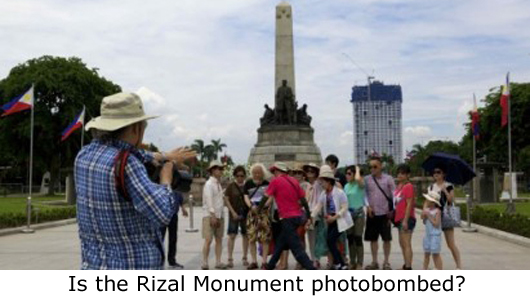
RizalMonument-Phobombed-530x300A 46-story condominium building – Torre de Manila – has risen in the city of Manila, creating a new and imposing backdrop for the city’s iconic Rizal Monument at the Luneta Park. Members of the Order of the Knights of Rizal claim that the condominium building is effectively photobombing and desecrating the venerable monument.

While the Order of the Knights of Rizal has won a temporary restraining order that stops work on the towering edifice, it is unlikely that the building’s construction will be permanently halted, or that the building – almost complete as it is – will be ordered torn down.

Opposition to the construction of the Torre is a natural reaction to change – change that drastically alters what we’re familiar with or – in this case – what we’re used to seeing. But once change takes place, people adjust to what’s new. Fifty years from today no one would mind that the Torre is seen in the background when visiting the Rizal Monument – because fifty years from today people would expect to see the Torre when they’re at the Monument.

Population growth, new technologies, and urban development result in change – and most times change requires a drastic revision of what we’re used to seeing or feeling.

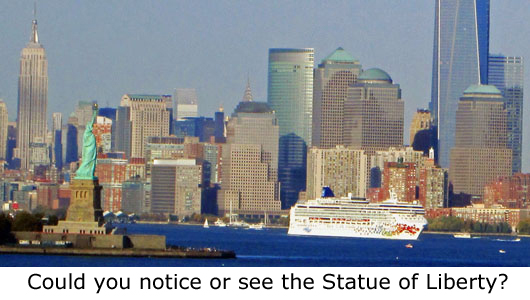
StatueOfLiberty-530x270The world is replete with examples of landmarks whose views were revised by such vicissitudes. Passengers on vessels entering the New York harbor will hardly notice the Statue of Liberty because of its imposing backdrop – the city and its skyline – a situation that might offend someone who lived in the 1900s. And the Eiffel Tower, from many angles, would hardly be noticeable were it not for its sheer, dominating size.

By the very law of nature, nothing is permanent. Change will take place, whether we like it or not. If it wasn’t the Torre de Manila, it would be something else, sometime, sooner or later.

If the Order of the Knights of Rizal is truly concerned about its view, they should consider rearranging the Rizal Monument so that it has the Manila Bay for a background. Having the city skyline – and its ever changing architecture – as a backdrop to the monument is a mistake.

Posted in Uncategorized | Tagged , , , , , , , , , | Leave a comment

What the world will be like after the demise of the electric utilities and the proliferation of the self-driving, self-healing electric vehicle


By2050TheGreenestOfCommunities-530Our fearless forecasts for the year 2050: (1) home and building rooftops laden with high-efficiency solar cells and light absorbers, (2) garages and building basements or rooftops equipped with high-capacity DC electric storage batteries, (3) hundreds of careers replaced by new professions, (4) the disappearance of oil refineries and gasoline stations, and (5) the demise of electric companies and their electric generation plants. All of these take place with the development of high-efficiency solar cells, new storage battery technologies, and the emergence of electric vehicles.

We will see the rapid expansion of home and business solar energy use, resulting in the dissolution of electric generators and their electric distribution networks or grids, e. g., the electric companies. In the place of electric companies and electric generating plants we will see the evolution of small community DC electricity exchanges.

We will see the development of careers involving the production and deployment of high-efficiency storage batteries and solar cells.

ElectricCar-500MilesOnASingleCharge-530We will see the disappearance of careers in vehicle maintenance, such as those involving oil changes, lubrication, engine and cooling systems repair, etc. Jobs in battery installation and conditioning will proliferate, as well as those for vehicle brake system repair and maintenance.

We will see new career opportunities in computer technologies involving electric vehicles and solar electric systems – careers in programming, maintenance, and security.

The biggest change will be in the type of electricity and voltage we use. Instead of today’s AC electricity (110V/60-cycles in the US and 210V/50-cycles elsewhere), we’ll be using 24V DC (direct current). This means there will be no danger from electrocution and all power can be easily stored, transmitted, and re-stored. [FACT: In today’s homes and businesses, all appliances – except light bulbs – use DC electricity.]

Makes for a dull life, you say? Yes, for those who’ve lived with and can’t let go of the old system. But for people who learn and love the new technologies it will be a wonder why the world ever used AC electricity at all. Thomas Edison and Nicolai Tesla will stir in their graves to celebrate their eventual victory over George Westinghouse, the man primarily responsible for making AC electricity the norm in the US and the rest of the world.

What comes after 24V DC, the storage battery, and the electric vehicle, you ask? How about human levitation and morphing, mental telepathy, and self-cloning for starters?

Posted in Uncategorized | Tagged , , , , , , , , , , , , | Leave a comment

On the Philippine Constitution’s mandate for separation of Church and State and the emergence of an Islamic nation within the country


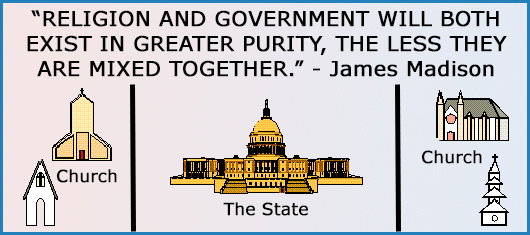
SeparationOfChurch&State-USEArticle II, Section 6 of the Philippine Constitution provides: “The separation of the Church and State shall be inviolable.” The mandate – which must never to be broken, infringed, or dishonored – is the most violated law of the land. There is no separation of church and state in the Philippines – the country is in fact a Christian religious state.

To make matters worse, a bill pending in the Philippine congress proposes the creation of an autonomous region to be known as Bangsamoro. The proposed Bangsamoro Basic Law (BBL) aims to settle armed rebellions by Muslim groups in the country’s south. If the bill becomes law, Bangsamoro will be an Islamic autonomous nation within a Christian state. And worse yet to come, the autonomous Bangsamoro region could later evolve into a fully sovereign nation for reasons of its being incompatible with a Christian state.

Let’s look at a few facts about religion and government in the Philippines:

  1. Politicians and political parties publicly compete for the endorsement and support of churches and religious organizations.
  2. Church leaders mobilize their flocks for political and other civic actions via their church sermons and public rallies.
  3. Church leaders make public statements denouncing or supporting certain government acts and activities.
  4. Priests and other church officials appear at state-sponsored activities and functions wearing their religious vestments.
  5. Because of church influence and pressure, the Philippines is the only country in the world outside of the Vatican that does not allow married couples to divorce. The Roman Catholic Church in the Philippines grants “legal separation” to married couples – but a legally-separated person cannot remarry.
  6. Neither the Roman Catholic nor the Iglesia Ni Cristo church displays the Philippine flag at their premises.
  7. Church leaders publicly reprimand, admonish, condemn and/or approve, commend or acclaim Philippine government officials for certain of their official actions or stances.
  8. Religion is taught in public schools where public school premises and equipment are used for such teaching in violation of Article III, Section 5 and Article VI, Section 29 of the Constitution.
  9. The Philippine government has no policy or program in place to enable the assimilation of the country’s Muslim population.

Churches and other religious institutions in the Philippines are required by law to register with the country’s Securities and Exchange Commission to which they could apply for tax-exempt status, and to which they are required to file annual financial statements. The Roman Catholic and Iglesia Ni Cristo churches turn a blind eye to these requirements.

To make things right, the Philippines should either repeal – or convincingly and credibly enforce – its Constitutional mandate for the separation of the Church and State.

Posted in Uncategorized | Tagged , , , , , , , , | 1 Comment

Year after year, the Philippine government’s Bureau of Customs is ranked as the country’s ‘Most Corrupt Government Office’


BureauOfCustoms-Philippines-530Because of its recent attempt to make OFW (overseas Filipino workers) ‘balikbayan’ boxes a target for its corrupt agents, the Philippine Department of Finance’s Bureau of Customs has once again come into public focus. In a US State Department investment climate report, the bureau was ranked as the “Most Corrupt Philippine Government Office.”

The balikbayan (repatriate) box is a Filipino tradition that dates back to 1987. Overseas Filipino workers – especially those in the United States – would send boxes of goodies and other gifts items to relatives in their home country via freight forwarders who charged very minimal fees. The balikbayan shipments were “door-to-door” – the boxes were picked up from the sender’s home and delivered directly to the recipient’s Philippine address.

Filipinos took advantage of this method for sending gifts to relatives after then-President Corazon Aquino issued an executive order in 1987 allowing shipments by overseas Filipino workers to be tariff-free. Subsequently, the Tariff and Customs Code of the Philippines was amended to provide duty- and tax-free privileges for balikbayan boxes. The ruling was in recognition of OFW “sacrifices in foreign lands” and their remittances to the country “of considerable amounts of foreign exchange.” The typical balikbayan box measures 24”x18”x24”.

The Bureau of Customs’ recent directive that would have subjected the balikbayan boxes to “random inspections” became an immediate target of an outraged net community. Opposition to the bureau’s move went viral. The predominant claim is that customs inspectors and agents were going to be free to “pilfer” from the boxes. Fortunately, President Benigno Aquino III issued an order to the bureau to abandon its plan.

Philippine Bureau of Customs police personnel, revenue agents, examiners, evaluators, assessors, etc. – its employees in general – are known around the country as among people who enrich themselves in office.

In the US State Department report, the Bureau of Customs corruption status was ranked “very bad” and the bureau’s efforts to eliminate graft and corruption in the agency as “execrable.”

Posted in Uncategorized | Tagged , , , , , , , , | Leave a comment